
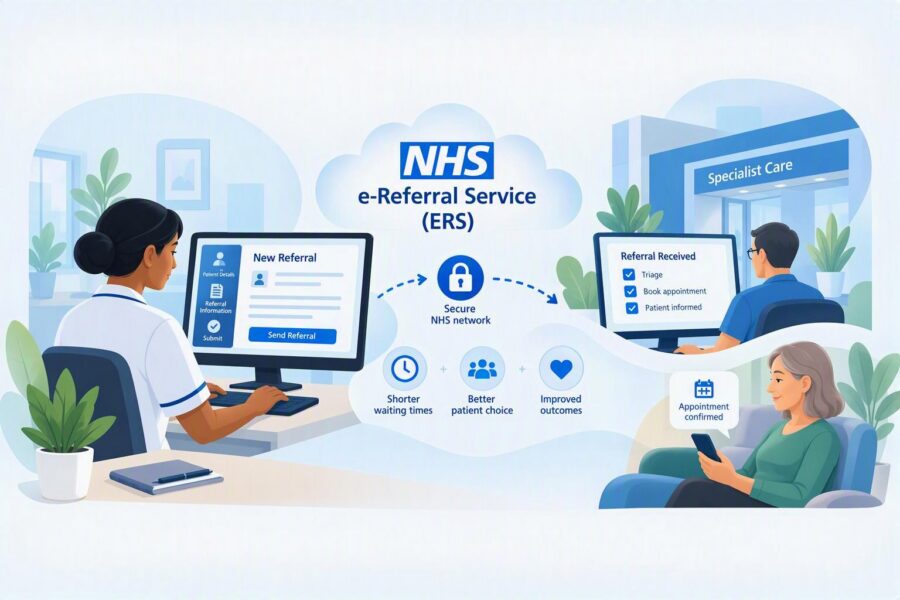
Practices will notice some changes to the NHS e Referral Service (eRS) from next month.
These changes support the introduction of the Elective Single Point of Access (SPoA) model.
Elective SPoA is a model where all Advice and Guidance (A&G) requests and elective referrals, other than those for urgent suspected cancer, are directed into a single digital entry point within secondary care.
Specialist clinical review of general practice enquiries and referrals is undertaken within eRS. This determines the most clinically appropriate next step for the patient, enabling straight to test and other diagnostic and management pathways.
It is important to be clear that this is not the wholesale change to referral processes that had originally been envisaged. Practices will still be able to use Advice and Guidance and make a referral as separate options. A referral cannot automatically be dealt with as A&G and sent back.
In practical terms, the national change is considerably more limited than originally anticipated. Rather than a single, consistently configured access route, practices should expect a series of locally designed services, with the detail varying by trust, specialty and subspecialty.
The current expectation is that providers will have implemented SPoA across at least 10 high-impact specialties by October 2026. The supporting e-RS release is currently planned for 09 October 2026, subject to final testing and release approval.
The clinic choices and service names shown in eRS may look different as trusts add their SPoA options, which they would like General Practice to prioritise rather than continuing with historic referral routes.
Despite the name, there will not be a single SPoA option for each trust. There are likely to be multiple SPoA services within each trust, covering individual specialties and, in some cases, subspecialties. Practices should continue to use clinical judgement and select the eRS option that best meets the patient’s needs. Where a referral is required, this can still be made separately from A&G.
One of the more notable changes is that A&G will no longer be limited to obtaining advice to support management in general practice before deciding whether to refer. It may now also be used for patients in the following three categories:
- A patient for whom advice is needed before a possible referral
- A patient who has already been referred and is waiting for an outpatient appointment or treatment
- A patient who is already under the care of a hospital specialist or clinical team
This broader use of A&G should give practices a clearer route to seek specialist input when a patient’s circumstances change, when further advice is needed while they are waiting, or when clarification is required from a team already involved in their care.
This change does not alter existing professional responsibilities for patients already under the care of specialist services, and practices should continue to follow established local arrangements regarding clinical responsibility, monitoring and follow-up.
Further local information will be shared as providers implement Elective SPoA services and confirm any changes to their individual service listings or referral routes. National help can also be sought through the NHS e-RS workspace on NHS Futures https://future.nhs.uk/ereferralservice and for support queries colleagues can email [email protected].